Slander Door
Selecting a high-speed fabric door is a practical decision for warehouses seeking faster movement, cleaner zones, and safer traffic flow. This guide examines China’s top 10 high-speed fabric door manufacturers through performance, design, service, and application value. It asks a useful operational question: Why do high-speed fabric doors improve warehouse efficiency? In busy facilities, every delayed opening can interrupt forklifts, workers, temperature control, and production schedules.
From practical warehouse experience, rapid opening and closing can reduce waiting time at loading bays and internal passages. A door that opens within seconds helps forklifts move smoothly between storage, manufacturing, and dispatch areas. Operators also value reinforced fabric curtains, clear vision panels, bottom safety edges, and reliable control systems. These features make daily movements more predictable. Small details matter. However, performance depends on more than advertised speed. Installation quality, maintenance access, local climate, and replacement-part availability can strongly influence service life.
This introduction sets a professional framework for comparing leading Chinese suppliers. It considers product materials, wind resistance, safety functions, customization, certifications, customer support, and documented project experience. Readers should verify technical data and request clear warranty terms before making a decision. No ranking is perfect. Some specifications look impressive on paper but may not match a warehouse’s real traffic pattern. A reliable choice balances purchase cost with energy savings, downtime control, worker safety, and long-term maintenance. The best door is not always the fastest one. It is the one that performs consistently during every shift.
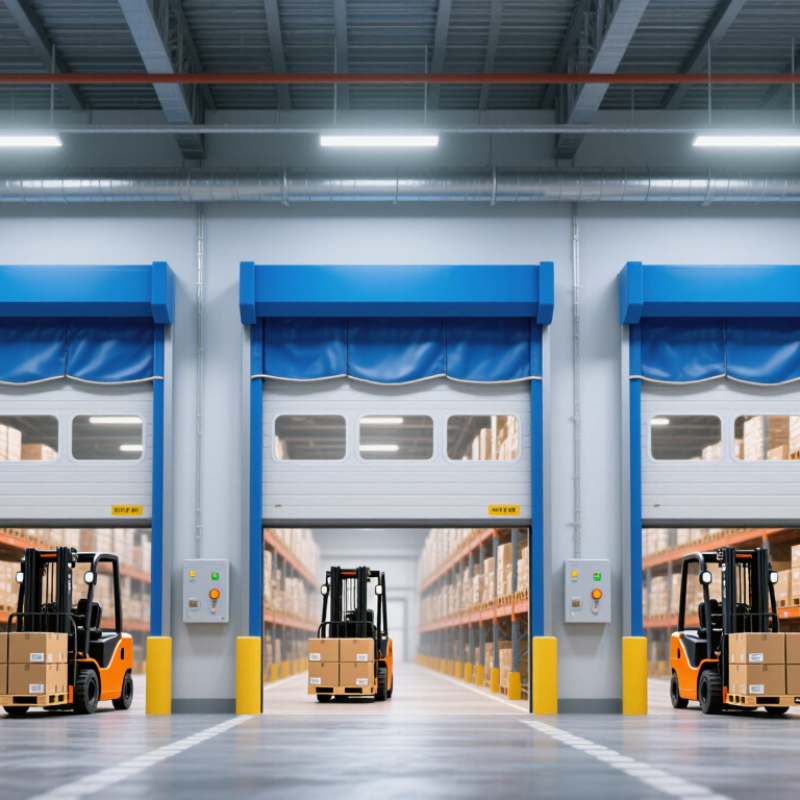
China’s top 10 high-speed fabric doors are best understood as practical product categories, not a fixed brand ranking. Common choices include roll-up doors, folding doors, self-repairing doors, insulated doors, freezer doors, cleanroom doors, dust-control doors, wind-resistant doors, vertical stacking doors, and custom-sized doors. Each design suits a different working condition.
In factories, roll-up fabric doors support frequent forklift traffic and reduce waiting time between rooms. Folding models provide wider openings for warehouses and loading areas. Self-repairing doors can return to their guides after minor impacts, reducing maintenance interruptions. Insulated and freezer models help protect temperature-controlled spaces. Cleanroom versions use smooth surfaces and controlled sealing, while dust-control doors limit air movement around production zones.
The right choice depends on speed, opening size, pressure, temperature, and daily cycles. Experienced buyers should request cycle-test data, fabric specifications, motor protection details, and installation records. Wind-resistant structures matter at exterior entrances, especially during strong weather. A low purchase price may appear attractive, but weak sealing or poor alignment can increase energy and repair costs. That is easy to overlook.
Suppliers should also explain spare-part availability and emergency operation procedures. Site measurements must be checked twice. Even a well-designed door may perform poorly when the floor is uneven or traffic patterns are misunderstood. Reliable selection combines factory evidence, realistic operating needs, and professional installation rather than attractive specifications alone.
High-speed fabric doors are designed around movement, safety, and repeated daily use. Engineers begin by studying the opening size, traffic frequency, temperature, pressure, and available space. The curtain usually uses reinforced PVC or coated polyester fabric. Its flexible structure reduces impact damage and supports quick operation. Side guides keep the curtain aligned, while a motor, control panel, and safety sensors manage each cycle.
Manufacturing requires more than cutting fabric and installing hardware. Technicians weld curtain seams, reinforce stress points, and check the bottom edge for reliable contact. Each door should be tested for opening speed, closing control, sensor response, wind resistance, and emergency release. Materials must match the operating environment. Food areas may need smooth, easy-clean surfaces, while warehouses may require stronger fabric and guide systems. No design is perfect. Poor installation, neglected sensors, or an unsuitable fabric can reduce service life quickly.
Tips: Measure the opening several times before production. Ask for material specifications, safety test records, maintenance guidance, and evidence of factory quality control. Confirm that the door meets applicable local safety requirements. Keep the control area dry and inspect the fabric, guides, and sensors regularly. A short inspection can prevent a costly interruption.
The top 10 high-speed fabric doors are defined by measurable performance, not attractive catalogs. A 2023 International Energy Agency report states that buildings consume about 30% of global final energy. Therefore, insulated curtains, tight side guides, and reduced opening time matter in warehouses and clean production areas. A practical target is a curtain speed near 1.5 to 2.5 meters per second, depending on traffic and safety controls. Faster is not automatically better.
Reliable doors need presence sensors, photoelectric protection, emergency release, and automatic reverse functions. Their fabric should resist repeated folding, abrasion, moisture, and temperature changes. Wind resistance also deserves testing, especially near loading bays. EN 13241 and ISO 13849-1 provide useful references for door performance and safety-related control systems. Ask for test results, not promises.
The strongest designs support thousands of operating cycles with simple maintenance access. Replaceable vision panels can improve visibility without changing the full curtain. Good sealing reduces dust movement and uncontrolled air exchange. The U.S. Department of Energy identifies infiltration as a significant source of building energy loss, making this detail practical rather than decorative. However, published cycle ratings may not match real sites. Forklift impact, poor alignment, and neglected sensors can shorten service life. That assumption needs testing. A site survey should examine traffic volume, temperature, pressure differences, and available repair skills before selecting the final configuration.
Why Choose China Top 10 High Speed Fabric Doors?
High speed fabric doors can make industrial operations more stable. They open and close quickly, reducing waiting time between production areas. In a busy warehouse, forklifts may pass through dozens of times each hour. Faster movement helps reduce traffic, cold-air loss, and unnecessary energy use. The flexible fabric curtain also lowers damage risks during minor contact. That matters on crowded floors.
These doors support cleaner and safer working conditions. Sealed edges can limit dust, insects, and temperature changes between rooms. In food processing, cold storage, and pharmaceutical facilities, this separation protects process control. Door sensors can detect vehicles and workers before the curtain moves. Transparent viewing panels may improve visibility near intersections. Small details count.
Selection still requires technical judgment. Door size, wind pressure, opening frequency, and ambient temperature must match the site. A low-cost model may fail when exposed to constant impacts or moisture. No door is maintenance-free. Regular checks should cover sensors, guides, fabric tension, and emergency release systems. Installation records and performance tests provide useful evidence for future inspections. In my experience, rushed specifications create more trouble than slow purchasing decisions. Even a well-designed door can underperform when operators ignore cleaning or servicing schedules.
Typical performance comparison of ten commonly used high-speed fabric door configurations in industrial facilities
| No. | High-Speed Fabric Door Configuration | Typical Industrial Application | Typical Opening Speed | Typical Maximum Size | Main Operational Improvement | Typical Safety Features | Environmental Benefit |
|---|---|---|---|---|---|---|---|
| 1 | Roll-Up Interior Fabric Door | Production halls, warehouses, and internal traffic routes | 0.8–2.0 m/s | Approximately 5 m wide × 5 m high | Reduces waiting time for forklifts and supports smoother material flow | Photoelectric sensors, bottom-edge detection, emergency stop, and automatic reopening | Limits air exchange between adjacent indoor areas |
| 2 | Self-Repairing Flexible Door | Busy warehouse entrances and logistics corridors | 0.8–1.5 m/s | Approximately 4.5 m wide × 4.5 m high | Reduces downtime after accidental impact because the curtain can re-enter its side guides | Safety light curtain, soft bottom edge, impact detection, and manual release | Maintains separation of temperature-controlled or dust-sensitive areas |
| 3 | Insulated High-Speed Fabric Door | Cold rooms, chilled storage, and food-processing areas | 0.6–1.5 m/s | Approximately 4 m wide × 4.5 m high | Shortens open time and helps stabilize internal temperature | Safety sensors, emergency release, insulated curtain panels, and controlled closing | Reduces heat transfer and unnecessary refrigeration demand |
| 4 | Cold-Storage High-Speed Door | Freezer rooms, loading areas, and temperature-controlled warehouses | 0.8–2.0 m/s | Approximately 4 m wide × 4.5 m high | Helps reduce frost formation and limits temperature fluctuation during traffic | Photoelectric sensors, heated or protected components where required, and emergency opening | Supports lower refrigeration losses by minimizing open-door duration |
| 5 | Cleanroom High-Speed Fabric Door | Pharmaceutical, electronics, medical, and precision manufacturing areas | 0.5–1.5 m/s | Approximately 4 m wide × 4 m high | Improves room-to-room pressure control and reduces contamination transfer | Interlocking controls, sealed side guides, photoelectric sensors, and controlled access | Helps maintain controlled air quality and reduces unnecessary air exchange |
| 6 | Dust-Control Fabric Door | Cement, ceramics, woodworking, mineral processing, and bulk-material areas | 0.8–1.5 m/s | Approximately 5 m wide × 5 m high | Separates dusty zones from cleaner production and storage areas | Safety edge, photoelectric sensors, reinforced curtain, and automatic closing | Reduces migration of airborne dust between work zones |
| 7 | Wind-Resistant Exterior Fabric Door | Factory loading docks, dispatch bays, and external warehouse openings | 0.8–1.5 m/s | Approximately 6 m wide × 6 m high | Provides faster access while improving control of outdoor air and weather exposure | Wind-resistant guides, reinforced curtain, warning lights, and photocells | Helps reduce drafts, rain entry, and energy loss at exterior openings |
| 8 | Fire-Rated or Fire-Compartment Fabric Door | Industrial buildings requiring compartmentalized fire protection | Application-dependent; normally closes automatically during an alarm | Depends on the certified system and opening design | Maintains daily traffic efficiency while supporting fire-compartment separation | Fire alarm interface, emergency power or release system, obstruction detection, and fail-safe controls | Limits the movement of smoke and heat when activated, subject to certification |
| 9 | Traffic-Control Fabric Door | Automotive plants, assembly lines, and high-frequency internal routes | 1.0–2.0 m/s | Approximately 5 m wide × 5 m high | Supports frequent vehicle movement and reduces congestion at internal openings | Radar or loop activation, photocells, safety edge, and programmable opening logic | Reduces unnecessary exposure between process areas with different air conditions |
| 10 | Large-Opening Reinforced Fabric Door | Aircraft maintenance, heavy-equipment facilities, and oversized logistics bays | 0.5–1.2 m/s | Often above 6 m wide or 6 m high, subject to engineering design | Provides rapid access for large vehicles while using less structural space than many rigid doors | Reinforced curtain, multiple safety sensors, emergency manual operation, and wind monitoring | Reduces the time that large openings remain exposed to outdoor conditions |
Why Choose China’s Top 10 High-Speed Fabric Doors?
Businesses should compare doors by operating conditions, not catalogue rankings. Start with opening speed, daily cycles, clear opening size, and indoor temperature control. Grand View Research estimated the global high-speed doors market at about USD 4.7 billion in 2023. That growth reflects demand for faster logistics and cleaner production areas. However, market growth does not prove product suitability.
Request measured data, not general promises. Check opening speed, closing speed, wind resistance, air leakage, safety sensors, and curtain replacement time. ISO 12100 and EN 13241 provide useful references for machinery safety and industrial door performance. A cold-storage facility needs different insulation from a busy loading dock. Food-processing sites also require washable surfaces and controlled access. Small details matter.
Ask for cycle testing records. A door used 100 times daily may need a different motor than one used 1,000 times. Confirm spare-part availability, technician response time, warranty limits, and control-system compatibility. The lowest quotation can be misleading. It may exclude installation, electrical work, or future curtain repairs. A 2024 report from MarketsandMarkets projected continued growth in industrial door demand, but forecasts are not guarantees. Visit a working installation if possible. Watch the door during peak traffic. It should reopen safely, close consistently, and avoid long pauses. Some comparisons still rely too heavily on price. That is a weakness worth correcting.
Engineers study opening size, traffic frequency, temperature, pressure, and available installation space. Flexible fabric, side guides, motors, controls, and sensors work together. Measure twice.
Reinforced PVC or coated polyester fabric is commonly used. These materials support fast movement and can reduce damage after light impacts. Material choice still depends on temperature, cleaning needs, and traffic intensity.
Check sensors, controlled closing, emergency release, and reliable bottom-edge contact. The door should reopen when an obstruction appears. Sensors need regular inspection.
Compare operating conditions instead of relying on rankings or attractive catalog images. Review opening speed, daily cycles, clear opening size, wind exposure, and temperature requirements. Price alone misleads.
Food areas usually need smooth, washable surfaces and controlled access. The curtain should resist frequent cleaning without creating difficult seams or hidden dirt points. Details matter.
A door operating 1,000 times daily may need a stronger motor than one operating 100 times. Request cycle-testing records and compare them with actual traffic patterns. Guessing is risky.
Request material specifications, safety test records, maintenance instructions, warranty limits, and factory quality-control evidence. Also confirm spare parts, technician response times, and installation costs. Ask clearly.
Inspect the fabric, guides, sensors, and control area regularly. Keep electrical controls dry and watch for damaged seams, misalignment, or delayed reopening. No checklist is perfect. A short inspection can prevent a costly stoppage.
China’s top 10 high-speed fabric doors represent practical solutions for warehouses, factories, logistics centers, and other demanding industrial environments. This overview explains what distinguishes these doors, how they are designed and manufactured, and which features matter most, including rapid opening and closing, durable fabric curtains, reliable control systems, safety sensors, insulation, and resistance to frequent operation. Their construction is generally focused on balancing performance, maintenance convenience, energy management, and long-term durability.
Why do high-speed fabric doors improve warehouse efficiency? They help reduce unnecessary air exchange, dust entry, temperature fluctuations, and waiting time between work areas, allowing vehicles, personnel, and materials to move more smoothly. The article also discusses how businesses can compare door speed, dimensions, operating cycles, safety functions, environmental suitability, installation requirements, service support, and total ownership costs. By evaluating these factors against their specific workflow and facility conditions, companies can select a high-speed fabric door that improves productivity, supports safer operations, and delivers dependable value over time.